
Back & Sciatica Physiotherapy
Assessment, treatment, and rehabilitation for back pain and sciatica in Mayville, Pretoria — helping you move, sit, and work with confidence.
- No referral needed
- Medical aid billed directly
- Full-hour assessment
Introduction
Lower back pain is one of the most common reasons people book physiotherapy in Pretoria, affecting everything from sitting at a desk and sleeping comfortably to lifting your child, walking the dog, or getting through a full day at work. Around 80% of adults experience lower back pain at some point in their lives, and sciatica (nerve-related pain that travels into the buttock or leg) affects roughly 2 to 5% of the population at any given time. Whether your pain came on suddenly after lifting something awkwardly, or has been building slowly over months of desk work, you're not alone in it.
Back pain has many names: lumbago, lower back strain, disc bulge, sciatica, lumbar radiculopathy, facet joint pain. The label matters less than the pattern. When pain starts travelling into the buttock or leg, it can feel alarming and unpredictable, often leading people to worry that something serious is wrong or that they'll need surgery. The reassuring reality is that most back and sciatic pain is mechanical rather than structural, manageable with the right approach, and responds well to physiotherapy focused on restoring movement, strength, and confidence, not just symptom relief.
At Peak Physiotherapy in Mayville, we treat lower back pain and sciatica in patients from The Moot, Wonderboom, Les Marais, and Rietfontein, as well as further afield across Pretoria. A full-hour first assessment gives us time to understand your specific pattern (mechanical, disc-related, nerve-driven, or a combination) and build a treatment plan from there, rather than working from a generic protocol.
Anatomy & Biomechanics
The lower back, known as the lumbar spine, is built to balance strength and mobility. It connects the upper body to the pelvis and plays a major role in bending, lifting, twisting, walking, and absorbing load throughout the day. Rather than being rigid, the spine is designed to move and to share load across multiple structures.
Pain often develops when these structures are exposed to repeated strain, prolonged postures, reduced movement variety, or sudden changes in activity levels. Importantly, this does not mean the spine is fragile or "out of alignment." The spine is remarkably strong and adaptable, and symptoms usually reflect temporary sensitivity or reduced load tolerance rather than damage. Sciatic pain occurs when nerves become irritated or sensitised, leading to symptoms that may travel into the leg without necessarily indicating nerve injury.
Understanding this matters because many patients arrive worried their spine is "out of alignment," a disc is "slipped," or damage has been done that can't be undone. In most cases, none of this is true. Discs don't slip. Spines don't fall out of alignment. What's usually happening is temporary sensitivity: tissues that have become irritated, movement patterns that have narrowed, muscles that have deconditioned, and a nervous system that has become protective. All of that is reversible with the right rehabilitation approach.
- Lumbar vertebrae – providing structural support
- Intervertebral discs – acting as shock absorbers between the bones
- Facet joints – guiding and controlling spinal movement
- Muscles and ligaments – providing stability and movement
- Nerves – including the sciatic nerve, which travels from the lower back into the leg
What Causes the Pain (Acute vs Chronic)
Back pain and sciatica can begin suddenly or develop gradually over time, and both patterns are very common.
Acute pain often starts after a clear trigger such as lifting something heavy, bending and twisting awkwardly, a sudden movement during sport, or even getting out of the car after a long drive. These episodes can feel intense, but they usually reflect temporary overload or irritation, not serious injury.
Chronic or persistent pain tends to build up slowly and is often linked to a combination of factors rather than one single cause. Prolonged sitting, reduced activity, poor sleep, work-related postures, repeated lifting, stress, or returning to exercise too quickly can all contribute. Over time, the spine and nervous system may become more sensitive to everyday loads.
Sciatica specifically develops when a nerve root in the lower back becomes irritated or sensitised, sometimes from a disc bulge pressing on nearby tissue, sometimes from muscle tightness in the piriformis or deep gluteal region, sometimes from prolonged sitting or postural loading, and often from a combination. Pain typically travels down the back of the thigh, past the knee, and sometimes into the calf or foot. It can feel sharp, burning, shooting, or accompanied by tingling and pins-and-needles. Most cases settle with structured physiotherapy over 6–12 weeks, without needing injections or surgery.
- These conditions are extremely common
- There is often no single clear cause
- Pain usually develops from a build-up of smaller stresses
- The body's tissues are adaptable and respond well to rehabilitation
Common Symptoms
Back and sciatic pain can vary widely, but commonly includes:
- A dull ache, stiffness, or sharp pain in the lower back
- Pain that travels into the buttock, thigh, or leg, sometimes below the knee
- Tightness, burning, tingling, or pins-and-needles in the leg or foot
- Symptoms aggravated by sitting, bending, lifting, or twisting
- Increased stiffness after long periods of rest or first thing in the morning
- Partial relief with movement, walking, or changing positions
How This Affects Your Day-to-Day
Back pain and sciatica rarely stay contained to just a sore back. It can quietly reshape how you move through an ordinary day.
- Hesitating before bending down or tying your shoes
- Dreading a long drive, knowing your back will be stiff before you arrive
- Struggling to find a comfortable position at night
- Thinking twice before picking up your child or loading the car boot
For many people, it's not just the pain itself, but the constant awareness of it that wears them down.
Why It Might Not Be Improving
A few patterns commonly keep back pain and sciatica lingering longer than they need to:
- Resting completely rather than staying gently active. This often stiffens the back further rather than settling it.
- Avoiding movement out of fear of causing more damage. Understandable, but this tends to reduce strength and confidence over time rather than protect the back.
- Managing only the symptom, such as heat, occasional stretching, or pain medication, without addressing what's actually driving the load through the spine.
- Not having a clear diagnosis yet. Without knowing your specific pattern, it's hard to know what actually needs to change.
- Returning to normal training, lifting, or activity too quickly, before movement and strength have properly recovered.
The Solution: Getting the Right Diagnosis
Understanding exactly which pattern fits your pain, rather than guessing, is the most reliable way to break this cycle.
Common Diagnoses
Many different labels are used for back and sciatic pain. While diagnoses can be helpful, they don't always predict pain levels or recovery, and imaging findings often do not match symptoms.
Non-specific lower back pain
is the most common presentation. There's no single structure at fault. Instead, a combination of muscle tension, joint stiffness, and reduced movement tolerance produces the pain. Despite the vague name, this pattern responds very well to physiotherapy focused on restoring movement and gradually rebuilding load tolerance.
Lumbar disc bulge or herniation
refers to disc changes that may irritate nearby nerves. Scans commonly show bulges in people without any pain, so a diagnosis on imaging isn't the whole picture. Most disc-related back pain settles with rehabilitation focused on movement, nerve gliding, and progressive loading, without needing surgery.
Sciatica (lumbar radiculopathy)
is nerve-related leg pain caused by irritation or sensitivity of a nerve root. Symptoms travel from the lower back into the buttock or leg. Physiotherapy for sciatica focuses on desensitising the nerve, restoring lumbar movement, and building strength through the hip and core.
Facet joint pain
develops in the small joints at the back of the spine, often causing pain that's worse with bending backwards or twisting. Joint mobilisations, targeted exercise, and postural retraining are the mainstays of physiotherapy treatment.
Degenerative disc disease
sounds alarming but describes normal, expected changes in the spine that occur with age. These findings appear on most adults' scans, often with no pain at all. Physiotherapy focuses on function, strength, and movement rather than trying to reverse the imaging changes.
Muscle or ligament strain
is temporary overload of the soft tissues supporting the spine. Usually the shortest to recover from with the right combination of rest, movement, and progressive loading.
How Physiotherapy Can Help
Physiotherapy for back pain and sciatica starts with a full-hour assessment. This means understanding your symptoms in detail, watching how you move, screening for anything that needs medical referral rather than physiotherapy, and building a picture of what's actually driving your pain. You'll get a clear explanation of what's happening and why, in plain language, without unnecessary medical jargon or scare tactics.
Treatment is tailored to what your assessment shows, but typically includes a combination of:
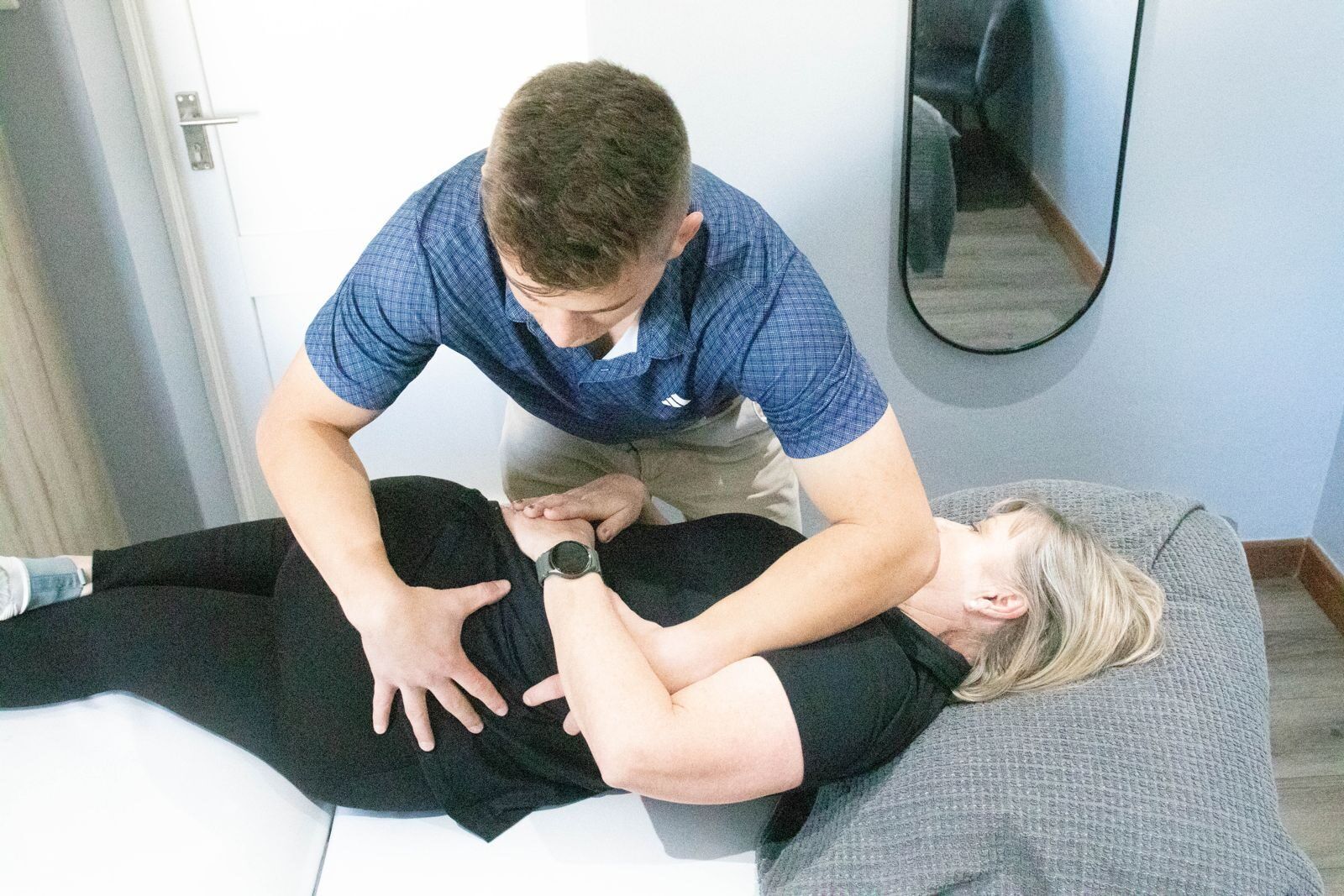
- Joint mobilisations to restore spinal movement and reduce stiffness in specific segments
- Dry needling for muscle tightness contributing to back pain, particularly in the paraspinals, gluteals, and piriformis
- Neural mobilisations to desensitise irritated nerves in sciatica presentations
- Therapeutic exercise: the most important long-term intervention, focused on rebuilding strength, control, and load tolerance through the hip, spine, and core
- Movement analysis using SFMA principles to identify what's driving repeated flare-ups
- Education and load management: how to sit, sleep, lift, train, and return to sport without provoking a flare
Recovery timelines vary and are always approximate. Acute back pain often improves substantially within 2–4 weeks. Chronic back pain and sciatica typically respond over 6–12 weeks of structured rehabilitation. In both cases, the aim isn't just short-term relief. It's rebuilding the strength, movement, and confidence that prevents recurrence.
We regularly treat back pain and sciatica in patients from The Moot, Mayville, Wonderboom, Les Marais, and Rietfontein, and we see post-surgical spine patients on referral from Life Eugene Marais Hospital.
Related Conditions We Treat
Not sure this is the right fit? These related conditions might explain what you're experiencing more precisely: Hip Pain, Mid-Back Pain, Neck Pain.
Frequently Asked Questions
Is walking good or bad for lower back pain?
Walking is one of the best things you can do for most types of lower back pain. Gentle, regular walking helps maintain circulation, reduces muscle guarding, and improves mood, all of which support recovery. Prolonged bed rest, on the other hand, tends to make back pain worse and slower to resolve. If walking makes your pain significantly worse, or you get shooting leg pain when walking, get assessed rather than pushing through.
Why does my back hurt worse in the morning?
Morning back stiffness usually reflects reduced movement overnight and temporary tissue sensitivity, not damage. Most people find it eases within 20–30 minutes of getting up and moving. Persistent, severe morning stiffness lasting hours can occasionally point to inflammatory conditions that warrant a medical assessment. Mention this to your physiotherapist during your first session.
Should I use heat or ice for back pain?
Both can help, and neither is a treatment on its own. Heat generally works better for muscular tightness and chronic stiffness; ice can help in the first 48 hours after an acute strain if there's swelling. Use whichever feels better. The evidence for one over the other is weak, and comfort matters more than protocol.
Can I still exercise or train with back pain?
In most cases, yes, with modifications. Complete rest usually delays recovery. The key is choosing movements you tolerate, avoiding the specific ones that flare your pain, and progressing gradually rather than pushing through. Part of what physiotherapy sorts out at your first session is exactly what to modify, what to keep doing, and what to avoid temporarily.
How do I know if my back pain is serious?
Most back pain isn't serious, but a few signs warrant urgent medical review, not physiotherapy first: loss of bladder or bowel control, numbness in the saddle area (inner thighs, groin, buttocks), progressive weakness in a leg, unexplained weight loss, fever, or pain that's severe and doesn't ease with any position change. If none of those apply, physiotherapy is a reasonable first step. You don't need a doctor's referral first.
Is sciatica serious?
Most cases of sciatica aren't serious and improve with structured physiotherapy over 6–12 weeks. Rarely, severe or progressive nerve symptoms need medical review. See the question above on warning signs.
Do I need an MRI or X-ray for back pain?
In most cases, no. International guidelines generally recommend against routine imaging for back pain because scan findings often don't match symptoms, and imaging rarely changes the physiotherapy treatment plan. If your presentation suggests something that would change management, we'll refer for imaging then, not by default.
How long does sciatica take to go away?
Most cases improve substantially within 6–12 weeks of structured rehabilitation, though this is always approximate. Some resolve faster; some take longer. Recovery depends on how long you've had it, how sensitive the nerve is, and how consistent you can be with the rehab plan.
Can physiotherapy fix a herniated disc?
Physiotherapy doesn't reverse the disc changes on imaging, but it doesn't need to. Most people with disc herniations improve symptomatically within 6–12 weeks with structured rehab, without needing surgery. The disc changes often remain visible on later scans even when the patient is pain-free. Treatment focuses on function, not the picture.
Do I need a referral to see you for back pain?
No. You can book directly with us. Most of our back pain patients book without a referral. If your medical aid needs a referral for reimbursement, we'll walk you through the process, but you don't need one to start treatment.
Do you bill medical aid for back pain treatment?
Yes. We bill most South African medical aids directly for physiotherapy treatment of back pain and sciatica. Get in touch and we'll confirm your specific plan's benefits before your first appointment.
Peak Physiotherapy · Mayville, Pretoria
Ready to get moving again?
Book an assessment and get a clear plan for back & sciatica pain — no referral needed.